Military Justice: Courts-Martial and the UCMJ
Key takeaways
- Service members are governed by the Uniform Code of Military Justice, a 1950 federal law that covers ordinary crimes and military offenses such as desertion and disobeying orders.
- Minor offenses are often handled by commanders through nonjudicial punishment, and serious ones go to courts-martial with military judges and panels of service members.
- Since December 2023 independent special trial counsel, not commanders, decide whether to prosecute sexual assault, murder, and other serious crimes.
- Service members must obey lawful orders but are required to refuse clearly unlawful ones, a principle tested at My Lai and debated again in 2025 and 2026.
- Appeals go to service courts, the civilian Court of Appeals for the Armed Forces, and sometimes the Supreme Court.
- Military commissions at Guantanamo, separate from courts-martial, have produced few convictions, and the 9/11 case has not reached trial.
The armed forces have their own justice system, created by Congress and run by the military, with its own crimes, courts, judges, and lawyers. It exists because military discipline is seen as essential and because troops serve around the world, far from civilian courts.
This guide explains how the system works, how it has changed, and the controversies over command influence, unlawful orders, and Guantanamo.
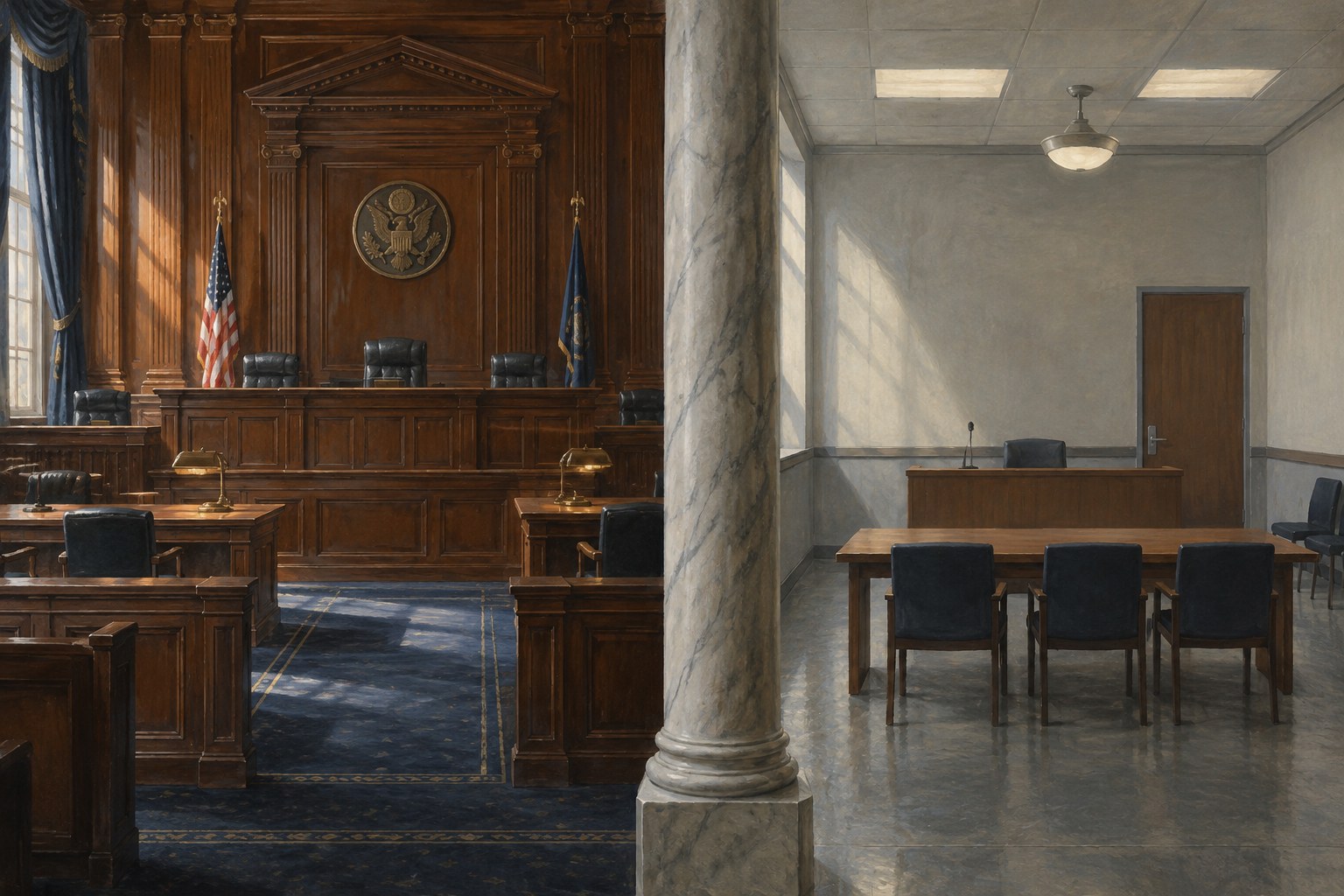
There are three kinds of court-martial: summary for minor offenses by enlisted members, special for midlevel offenses with up to a year of confinement, and general for the most serious crimes, with punishments up to death. Military judges preside, and the accused can choose a judge or a panel of service members, randomly selected since 2023. Since December 2023 independent Offices of Special Trial Counsel, rather than commanders, decide whether to prosecute sexual assault, murder, and other serious crimes. Defendants receive free military defense lawyers.

Military commissions are a separate system for trying enemy fighters for war crimes. Used since the Civil War, they were revived after 9/11 at Guantanamo Bay, struck down by the Supreme Court in 2006, and re-created by Congress in 2006 and 2009. They have produced few convictions, and the 9/11 case, in pretrial hearings since 2012, had still not gone to trial in 2026 after plea deals were withdrawn in 2024. Debates continue over command influence, sexual assault prosecutions, racial disparities in punishment, and whether to close Guantanamo.
Service members must obey lawful orders, but the code and military training say they must refuse orders that are clearly unlawful, such as an order to kill civilians, as the My Lai court-martial of 1971 showed. In November 2025 six Democratic lawmakers with military and intelligence backgrounds released a video urging troops to refuse illegal orders, and the Pentagon moved to reduce the retired rank of one, a senator and retired Navy officer. A federal judge blocked that move in February 2026 as a violation of his free speech rights, and the government appealed. In February 2025 the Secretary of Defense removed the top lawyers of the Army and Air Force, which critics said weakened legal checks.


Commanders have broad authority over discipline. For minor offenses they can impose nonjudicial punishment under Article 15, such as extra duty, loss of pay, or reduction in rank, without a trial, though most members can demand a court-martial instead. Commanders can also give administrative reprimands or start discharges. Critics have long warned of unlawful command influence, when commanders improperly sway cases, and the code makes it a crime.
Convictions are reviewed by appeals courts in each service and then by the U.S. Court of Appeals for the Armed Forces, five civilian judges appointed by the President for 15-year terms. Since 1984 the Supreme Court can review some of its decisions. The Court has held that the military may limit some rights, such as speech, more than civilian life allows, and in Ortiz v. United States in 2018 it confirmed its power to hear military appeals. Death sentences require presidential approval, and no service member has been executed since 1961.
The Constitution lets Congress make rules for the armed forces, and the Supreme Court has long accepted a separate military justice system. Congress enacted the Uniform Code of Military Justice in 1950, replacing older codes like the Articles of War. It applies to about 1.3 million active-duty members, reservists on duty, and cadets, and in some cases to retirees. It covers ordinary crimes and military offenses such as desertion, absence without leave, disrespect, and conduct unbecoming an officer. The President fills in details through the Manual for Courts-Martial.
See who commands the forces in the military chain of command, how civilian criminal cases work in how a federal criminal case works, or the services themselves in the armed forces explained.