How Money Is Made: The Mint, the Printing Bureau, and Fort Knox
Key takeaways
- The U.S. Mint makes coins, the Bureau of Engraving and Printing prints paper money, and the Federal Reserve orders the bills and puts them into circulation through banks.
- About 2.4 trillion dollars in paper money was in circulation at the end of 2025, most of it in 100 dollar bills, many held abroad.
- The Mint struck its last circulating pennies on November 12, 2025, after each one cost almost four cents to make.
- Fort Knox holds about 147 million ounces of gold, more than half of the nation's reserves, but the gold no longer backs the dollar.
- Most money exists as electronic bank balances, not cash, and when the Federal Reserve creates money it usually does so electronically.
- Congress decides what money exists, while the Treasury and Federal Reserve run the system.
The Constitution gives Congress the power to coin money and regulate its value. Congress has handed the daily work to two Treasury agencies that make coins and bills, and to the Federal Reserve, which decides how much paper money is needed and controls the overall supply of money in the economy.
This guide explains who makes what, what it costs, how the gold at Fort Knox fits in, how counterfeiting is fought, and the debates over pennies, cash, and digital money.
Supporters of ending the penny, and some who want to end the nickel, say the coins cost more than they are worth, while opponents worry about rounding and the zinc and copper industries. Some argue cash should be phased down to fight crime and tax evasion, while others say cash protects privacy and people without bank accounts, and several states have required stores to accept it. Debates also continue over who should appear on money, auditing the gold, and whether private stablecoins or a government digital dollar would better serve the public.


The Treasury owns about 261.5 million ounces of gold. About 147.3 million ounces sit in the Bullion Depository at Fort Knox, Kentucky, opened in 1937, and the rest is mostly at West Point, Denver, and the New York Federal Reserve. The gold is still carried on the books at 42.22 dollars an ounce, about 11 billion dollars, though its market value in 2026 is well over a trillion dollars. The dollar has not been convertible into gold since 1971. Calls for a public audit grew in 2025, and Treasury officials say regular audits show the gold is there.


The Mint sells coins to the Federal Reserve at face value, and the difference between face value and production cost, called seigniorage, goes to the Treasury. Pennies and nickels lose money: in fiscal 2024 a penny cost about 3.7 cents and a nickel about 13.8 cents to make. The administration ordered an end to penny production in 2025, and the Philadelphia Mint struck the last circulating pennies on November 12, 2025. Existing pennies remain legal tender, and some stores now round cash prices. For the 250th anniversary in 2026, the Mint issued special circulating designs, including a dollar coin bearing the image of the sitting President, which drew debate over putting a living President on money.

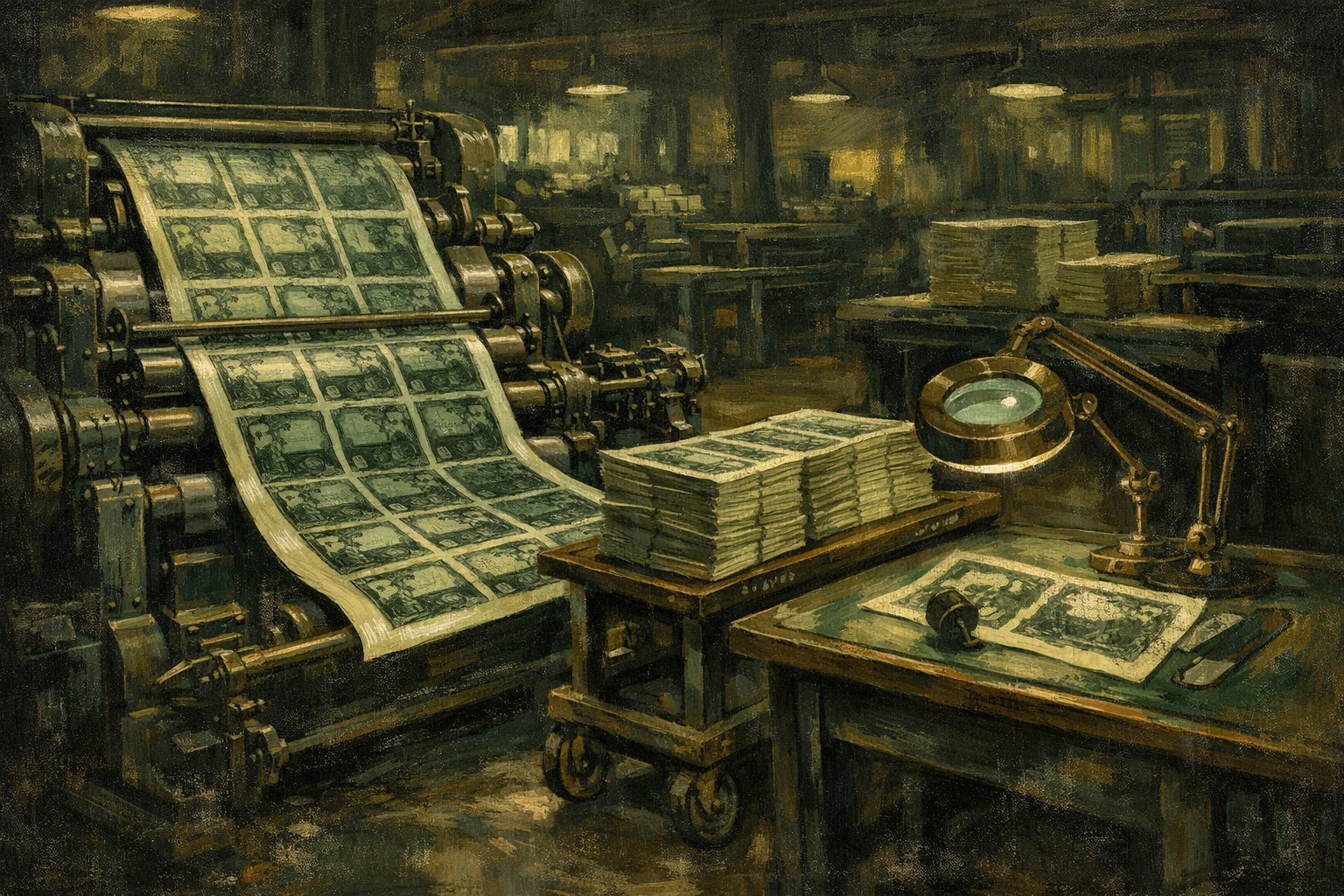
Article I gives Congress the power to coin money and regulate its value, and the Supreme Court upheld Congress's power to issue paper money in the 1870s. Today the Treasury Department oversees two money factories. The U.S. Mint, founded in 1792, makes coins in Philadelphia, Denver, San Francisco, and West Point. The Bureau of Engraving and Printing, which began printing notes in 1862, produces paper money in Washington, D.C., and Fort Worth, Texas. The Federal Reserve buys the bills at cost and distributes cash through banks.



The Secret Service was created in 1865 to fight counterfeiting, which then made up a large share of currency, and it still investigates fake money. Modern bills use color shifting ink, watermarks, security threads, and microprinting. Most money today is not cash but electronic balances at banks. When people say the Federal Reserve prints money, they usually mean it creates bank reserves electronically, for example by buying bonds. A 2025 executive order barred work on a U.S. central bank digital currency, and the GENIUS Act, signed July 18, 2025, set federal rules for dollar-backed stablecoins issued by private companies.


Each year the Federal Reserve Board estimates how many new bills are needed to replace worn notes and meet demand and sends a print order to the Bureau. About 2.4 trillion dollars in paper money was in circulation at the end of 2025, and 100 dollar bills made up nearly 2 trillion dollars of that, with much of it held overseas as a store of value. Bills carry the signatures of the Treasurer and the Secretary of the Treasury, and a new design series is planned for the late 2020s.
See how the money supply is managed in the Federal Reserve explained, what the government owes in the national debt explained, or what else the Treasury does in how the IRS works.